Barcelona


Barcelona (Barcelona Catalan, pronounced / bəɾsəlonə /, and in Spanish, pronounced / baɾθelona /) is the administrative and economic capital of Catalonia, Barcelona province, in the county of El Barcelonès and its urban area and its metropolitan area, Spain.

It is the second largest city in Spain in terms of population and activities, the eleventh most populous city in the European Union and the sixth including his banlieue3: More than 5 million people live in the metropolitan area barcelonaise4. The bulk of the adjacent municipalities are also gathered in Àrea Metropolitana de Barcelona.

Located on the Mediterranean coast, it is crossed by the rivers Llobregat and Besòs and bordered on the west by the Serra de Collserola which rises to 512 meters (summit Tibidabo). It is considered a global city because of its importance in the areas of finance, international trade, publishing, arts, entertainment and media. Barcelona is a major economic center, has, moreover, a major Mediterranean ports and the second behind the Spanish airport of Madrid-Barajas. It is also the city that has the largest metropolitan park in the world, the Collserola Park, before Central Park in New York. Having been founded by the Romans, the city became the capital of the Counts of Barcelona and one of the major cities of the Crown of Aragon. Redesigned several times during its history, today it is a major tourist destination and has a unique cultural heritage. The Palau Güell (1984), Casa Mila, Park Güell, the Palais de la Música Catalana and Hospital de Sant Pau appear elsewhere on the World Heritage List of UNESCO. In addition, the city is also known for hosting the Olympics in 1992 and, more recently, the headquarters of the Union for the Mediterranean.

Excavations have uncovered a part of the Roman city of Barcino which is exposed at the Museum of City History. These archaeological work has allowed the Barcelona City Council published a historical record on the history of the city from its beginnings to the present day. This file ends a persistent rumor, spread by teachers until the twentieth century although historically false "Hannibal Barca did not base Barcelona" 5 [ref. TBC], the son of Emperor Augustus.


In December 414, Barcelona is taken by the Visigoths Athaulf from Italy. Muslims take the town in the eighth century and the governor will appoint ben Sulayman ibn al-Arabi Yaqzan. Barcelona becomes part of al-Andalus. In 801, the Carolingian conquer the city; they turn it into the county capital of Barcelona, ​​before incorporating the Spanish March (Marca Hispanica, more precisely translated Marche Hispanic). In 859, Barcelona is sacked by Vikings head Hasting, who come from Nantes and had wintered in Camargue6. Over time, the county acquired a certain independence vis-à-vis the Carolingian dynasty whose reign officially ends in the tenth century. In 985, al-Mansur, the Caliph of Cordoba, a city in southern Spain, attacks and plunders Barcelona. He took with him many slaves. Count Borrell II asks for help to his sovereign Hugues Capet. It does not deigning to help him, as required feudal law, the county denounce his ties suzerainité and takes de facto independence.

Paradoxically, this event will mark the beginning of a phase of expansion of Catalonia; this move will involve other states in the Spanish Walk (Hispanic). On the one hand, many Mozarabes and Jews fleeing persecution in the Caliphate of Cordoba, will find refuge in the former states of the Spanish Walk; they bring all their knowledge and culture (in those days, there was no talk - in Spanish - "purity of blood"). On the other hand, in order to rebuild, farmers will hire their services as mercenaries of the caliph. Revenues in Catalonia, they will organize to defend themselves and employ agricultural techniques used in the Caliphate of Córdoba. They will thus build mills and irrigate the land. Trade with the Caliphate will grow rapidly. The result is a growing population and development techniques from the late tenth century. Monastic and push the development of pilgrimage to Saint Jacques de Compostela will allow the transmission of this technique to push other states in the Spanish March, then to the rest of Europe. This technical development is also accompanied by a large expansion of the culture. Pope Sylvester II studied in Barcelona where he completed his training in science. It reintroduces the ancient culture through Virgil, Porphyry of Tyre, Aristotle, Cicero and Boethius. It is through the latter that he was introduced to arithmetic. From there, he discusses the practical calculations and produces a table to count, called the abacus of Gerbert.

Another major fact, the presence of peasant soldiers who own their mill, will lead to a non-absolutist interpretation of feudalism. The kings of Aragon will face their third states. The establishment of a feudal state in Catalonia during the eleventh century did not involve the county of Barcelona who took a certain dominance over other counties in Marca. Barcelona became the center of an area that included the current Catalonia, various maritime possessions, and the Catalan-Aragonese confederation for much of its history. Barcelona was one of the major Mediterranean powers of the thirteenth to the fifteenth centuries


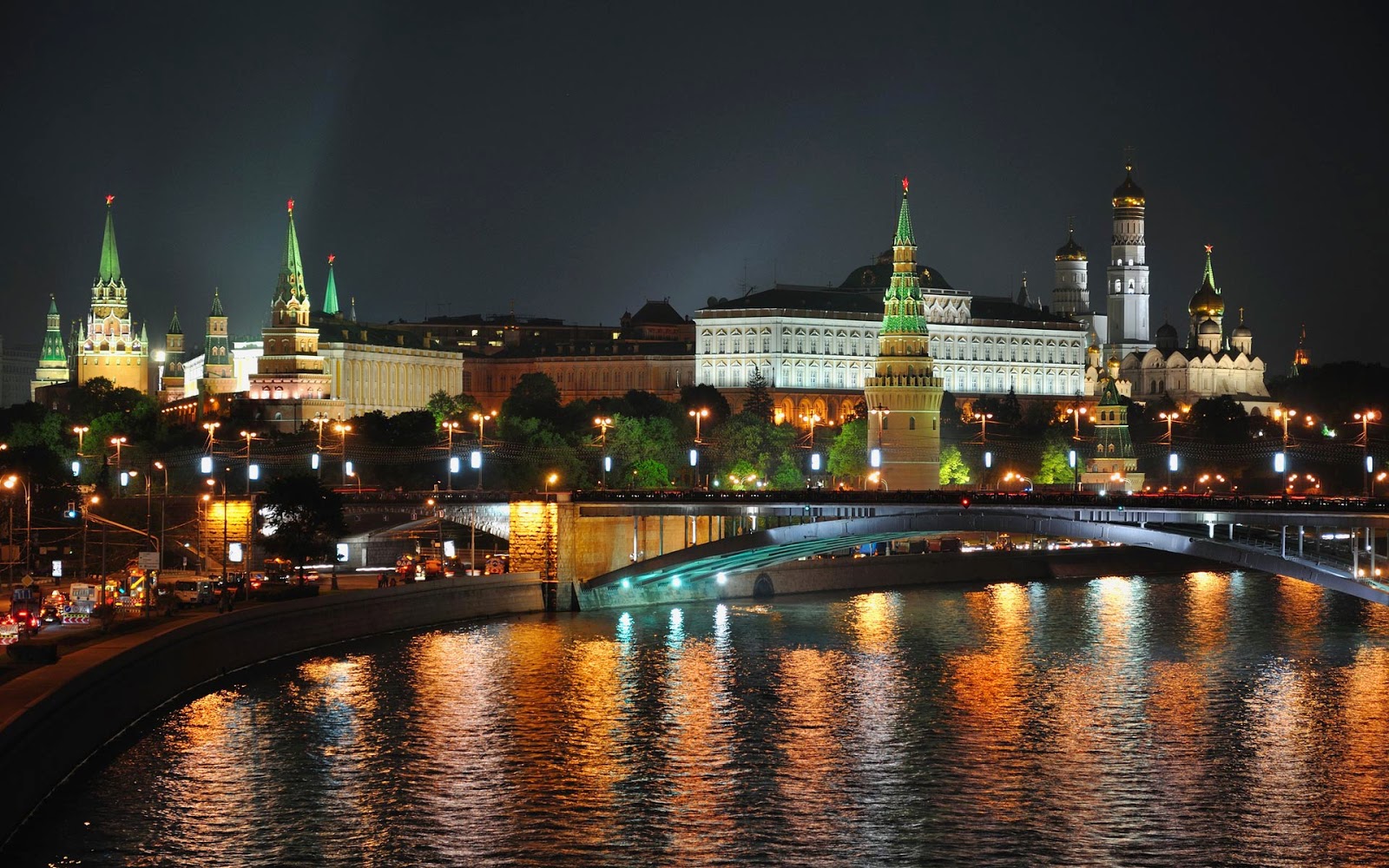
Moscow


Moscow (pronounced [mɔs.ku] Russian: Москва, Moskva, IPA: / mɐskva /) is the capital of the Russian Federation and the largest city in Europe. Moscow is situated on the Moskva River, which is the same name in Russian. The city is located in the European part of Russia and administratively in the Central Federal District. Moscow has the status of federal city. The city is an enclave in Moscow oblast but is administratively independent.

Moscow is both the most populous city in Europe, with 12 million people within the walls, according to the official census of 2013 and nearly 15 million people in the urban area, and the largest (more than 1,000 square kilometers). It is also the city whose budget is the highest compared to all other European capitals ($ 52 billion in 2012). It is the economic, political and academic head of Russia, comprising 8.9% of the population. Its inhabitants are Muscovites.

Moscow has played a big role in Russian history: it was the capital of the Grand Duchy of Moscow and the Russian Empire before Peter the Great transferred the capital to the new city of St. Petersburg. This city will remain the capital of Russia until the October Revolution, from which Moscow became the capital of the young Soviet Federative Socialist Republic and Russia in 1922, the Union of Soviet Socialist Republics. Moscow is also known for its architectural heritage: the Kremlin with its palaces and churches, St. Basil's Cathedral on Red Square, the Cathedral of Christ the Savior and the Seven Sisters Stalinist. Danilov Monastery in Moscow is the seat of the Patriarch of the Russian Orthodox Church.

The historic core of the city is located on the hill overlooking the left bank of the Moskva River, where today are the Kremlin and Red Square.

Moscow has long been known by the Russian people "Mother" (Matushka Moskva).

The city is home to many academic and cultural institutions of the Federation. Moscow hosted the Summer Olympics in 1980.

Moscow has an important place in the Russian economy: it produces 25% of GDP of the Federation. After seven decades of communism, Moscow has turned into a "giant capitalist" and 1 is needed in the European and global economy. The construction of the International Trade Centre in Moscow (CCIM), also called "Moscow-City" is the symbol of this transformation. But this change has not been without its problems. Socioeconomic differences became significant: part of the population is highly enriched while the rising cost of living has worsened the living conditions of the poorest.

Moscow is first mentioned in 1147 under the name Moskov, as a meeting of the princes of Vladimir Yuri Dolgoruky and Sviatoslav Olgovitch Novgorod-Severski2. The heart of the city lies at the confluence of two rivers, the Moskva and Neglinnaya. It is first protected with a simple wooden wall in the twelfth century3. The total area of the city does not exceed 5 hectares in the eleventh and twelfth centuries. It's a small town.

In the thirteenth century, Moscow became the heritage property cadet son of the dynasty of princes of Suzdal. There are princely palaces and three wooden churches, the oldest, St. John the Baptist, was the site of a pagan temple. The original town was destroyed in 1238 by the Tatars of Batu Khan. In the fourteenth century, under the leadership of its princes descended from Daniel Alexandrovich (1272-1303), son of Alexander Nevsky, she says slowly as the capital of Muscovy, and the russe4 State.

In the fourteenth century, Yuri III Moskovsky arguing with Michel Saint Vladimirski III, Prince of Tver, the throne of the principality of Vladimir-Suzdal (whose capital was the city of Vladimir). Ivan I, brother of Yuri, prevailed and became the sole collector of taxes for the Mongol overlords of the Golden Horde. This service allowed for concessions including pass control of the principality to the eldest and not to divide it between all children.

But when the growth of the Lithuanian empire began to threaten all of Russia, Moscow Khan strengthened, notably by the seat of the Orthodox church, allowing it to become the largest city in Russia. It is generally accepted that Ivan III finally liberated the city of Mongol control in 1480, ranking as the capital of an empire that will eventually encompass the whole of Russia, including Siberia and many other territories.

The tyranny of the subsequent rulers like Ivan the Terrible (first ruler to carry the title of Tsar), led to a weakening of the state, even when the empire extended. In 1571, the Crimean Tatars from the Ottoman Empire seized and burned the city. Between 1610 and 1612, Polish troops occupied Moscow as Poland tried unsuccessfully to install a monarch on the throne or form a union between the Slavic states. However, the Polish army was only partially supported by the aristocracy and its Russian counterpart led by Prince Pozharsky won the election of Mikhail Romanov.


Fifty religions are officially registered in the city but the population is predominantly Orthodox. The Moscow Orthodox represent 500 organizations, over 700 religious buildings (including 645 on), four male and five female monasteries monasteries. The city also has a community of Old Believers have available a dozen churches.

The Jewish community of about 80,000 people has personnel who have suffered greatly from the wave of emigration to Israel in the 1990s and has in the center of a synagogue choir. The city also has a Muslim community constituting between 10% and 15% of the total population, mostly immigrants from the former Soviet Union. Although more than 80% of them do not have Russian citizenship, Moscow has six mosques and twenty organizations. There are many Protestant communities, particularly dynamic (including Baptists) with forty places of worship. The Catholic Church has three parishes, including the Church of St. Louis of the French, built in the early nineteenth century.

As elsewhere in Russia belonging and religious practice have increased dramatically over the past decade and yards (over forty to date) church building in Moscow have become common, especially in the suburbs, the the most striking being the reconstruction of the Cathedral of Christ the Savior in the 1990s for example.


Pékin


Pékin (Chinese: 北京; pinyin: Beijing Listen to the pronunciation in Mandarin, literally "northern capital") is the capital of the People's Republic of China. Located in the north, the municipality of Beijing (北京市, abbreviated 北京), with an area of ​​16,800 km2, borders Hebei Province and Tianjin Municipality. Beijing is considered the political and cultural center of China, while Shanghai and Hong Kong predominate in economic terms.

First City peripheral of the Chinese empire under the Han and Tang dynasties, it becomes important when the Jurchen, who founded the Jin Dynasty, chose as their main capital in 1153 Mongol prince Kublai Khan actually same as the Dadu ("great city"), and finally the Ming are transferring their administration in 1421, completing the choice of Beijing as the capital of China. Located near the Great Wall, Beijing is home to famous landmarks such as the Forbidden City and the Temple of Heaven, which are listed as World Heritage. Many architectural and structural achievements have changed the city during the Olympic which it hosted in 2008 Games.

With 19.6 million inhabitants (2010), Beijing is the second most populous city in China after Shanghai. The urban area account for its 18 million inhabitants. The talk Pekingese form the basis of standard Mandarin. From an economic perspective, Beijing is the third largest city in China with total GDP, after Shanghai and Hong Kong. She knows very rapid economic growth, well above 10% per year in the 2000s a new central business district (CBD) is under construction.

The great plain of northern China, where Beijing is geologically a sedimentation area consists of alluvium brought for millennia primarily by the Yellow River, the richest in the world in mud river, whose foothills northern and southern Shandong Peninsula reach the Yellow Sea. It consists of alluvial loess and sand brought by the various rivers from the mountains of the West. This formed over time delta in northern China.

From a climate perspective (hot and humid and cold, dry winters summers with dust storms) and phytogeographical (landscape close to the characteristics of the steppes), the Beijing area is similar to the landscapes of neighboring hills.

The area is subject to frequent earthquakes due to tectonic activity and the slow passage of the Indian plate under the Eurasian continental plate. The speed of the tectonic plates of the averages of about four centimeters per year. Thus, July 28, 1976, occurred in Tangshan, 140 km east of Beijing, one of the most devastating earthquakes in the twentieth century (see the 1976 earthquake in Tangshan). With a magnitude of 8.2 on the Richter scale, the official death toll in deaths from the Government of the People's Republic of China refers to a figure of 242,419 with a power earthquake officially announced at 7.8, but some estimates put the figure of nearly 800,000 deaths. The earthquake also resulted in damage to Beijing and other cities in the region.

Beijing is facing many environmental problems. These include excessive pollution of rivers, problems in the supply of drinking water, high air pollution, inadequate public transport and increased traffic. Since the early 1990s, the government made ​​greater efforts to protect the environment. He has introduced legislation promoting recycling, normalizing the environmental impact assessment, energy efficiency and monitorant air pollution.

Since 1 January 2003, only personal cars meeting the Euro 2 standard could be registered in Beijing. Many diesel buses were replaced by vehicles running on natural gas. In addition, the number of electric trolley bus reached a total of 18,000 buses in Beijing. For rail, extensions of the subway system have been undertaken. The air pollution in the city is more serious. The high concentration of particulate matter and carbon dioxide are a major problem.

The air quality, according to WHO, remains one of the worst in the world. The reasons are many factories and power plants on the outskirts of the city, and the number of transport and household use, fuels pollutant. Due to rapid urbanization, the large increase in traffic volume and concentration of industries in the metropolitan area has led to excessive emission of pollution and smog is a serious threat to public health, respiratory diseases are increasingly important in the population of the capitale7.

To improve air quality, new stricter emission rules were enacted. Since 1 March 2008, all new cars must meet the Euro 4 emission standard, which is mandatory in Europe for new cars since January 2005 (Euro 5 has since entered into force in Europe in September 2009).

From 2008, the American Embassy measure pollution Pékin8.

Since October 2012, the Chinese government set up stations that measure air pollution in Pékin8. In January 2013, the city has 358 Beijing had no emergency air plan before the January 20138.

Concentration of less than 2.5 microns in diameter particles broke the record of 700 ug / m 3 for 3 days in January 20138. WHO recommends a maximum of 25 mg / m 3 averaged over 24 h8. Many flights were canceled due to a lack of visibility. This record is due to intense cold, causing a significant increase in heating with wood or coal. According to the IEA, China consumed half the mondial8 coal.
Moreover, the absence of wind, the number of vehicles fossil fuel and plant near Beijing centaines8 worsened the problem of air pollution.

The particles have killed a total of 8,600 people in 2012 to Beijing, Shanghai, Guangzhou and Xi'an9,8.

A study published in June 2013, conducted by the NGO Greenpeace and American experts, is centered on the core 196 coal located on the outskirts of Beijing. This pollution has killed nearly 2,000 Beijingers in 2011, and about 8000 in the province of Hebei.


Singapore


Singapore, Republic of Singapore long form, in English and Singapore Republic of Singapore, Mandarin Xīnjiāpō, and Xīnjiāpō gongheguo 新加坡, 新加坡 共和国, Malay Republik Singapura and Singapura, Tamil Ciṅkappūr, சிங்கப்பூர் and Ciŋkappūr Kudiyarasu, சிங்கப்பூர் குடியரசு is a city-state in Southeast Asia. Its area is 647.8 km2. It consists of 64 islands, of which the main one is Pulau Ujong (584.8 km2). This island is densely urbanized, but lush vegetation even downtown Singapore earned the nickname Garden City. This abundance of green stems in part from an equatorial climate, hot and stormy evenly throughout the year.

This city-state is located on an island at the southern tip of the Malay peninsula and is separated from the north by the Straits of Johor and south borders the Strait of Singapore. She is known throughout the world and often cited as a model for its extraordinary economic success. After independence in 1965, Singapore has managed to become, with very few natural resources and major socio-economic problems (such as riots, unemployment, housing difficulties and access to water), one of the countries most developed and most successful in the world in terms of economy, education, health, transparency, security and planning. The sovereign city, is a Chinese wedge in heart of the Malay world: the population is mostly composed of Chinese (76.8%). This ethnic confrontation in part the troubles that have accelerated its withdrawal from Malaysia, 9 August 19654.

In the 1980s, the country is one of the Four Asian Dragons, transition states and unbridled economic development. In 2011, Singapore is the third country in the world in terms of PPP per capita after Qatar and Luxembourg5. Trade and finance between the Pacific and Europe hub, the city owes its growth to its unique maritime location at the eastern end of the Straits of Malacca: This is the business city on the borders of the East, the second port the world (after Shanghai) in terms of exports and shipping. Singapore's population has a very high standard of living and the city-state is often called the "Switzerland of Asia" 6. In 2009, Singapore and had the highest concentration of millionaires based on the total population ahead of Hong Kong, Switzerland, Qatar and Koweït7. With remarkable political stability, Singapore is now considered an authoritarian democracy, with the same family in power since independence. The city-state is considered as a country practicing economic liberalism without political liberalism.

The center is located south of the island, at the mouth of the Singapore River (Singapore River). It features a business center that has made ​​the city the fourth financial center in the world, as well as different ethnic neighborhoods (Chinese, Malay, and Indian) and a large shopping area around Orchard Road.

Temasek ("the city of the sea" in Javanese), the former name of the island where Singapore is attested in the fourteenth century. The Nagarakertagama, an epic poem written in 1365 in the Javanese kingdom of Majapahit, mentions "Tumasik" ​​among a few hundred "dependent regions" of the kingdom. In reality, the territory controlled by Majapahit extended only over part of the eastern and central Java. The "dependent countries" were actually counters forming a sales network which was the center of Majapahit. Majapahit was sending dignitaries whose role was to ensure that these counters do not engage in private business that falls outside the realm.

The island was named Singapura ("Lion City" in Sanskrit) in the fourteenth century by Parameswara (also known as Sang Nila Utama), a prince from Palembang in South Sumatra Indonesia would have exiled for refusing suzerainty of Majapahit after an attack of it in 1377.

In fact, there has never been a lion on the island but tigers (there is however a well Asiatic lion, Panthera leo persica). The explorers were probably hit a fawn of the jungle and have likened to a lion. The symbolic animal of Singapore is a lion-tailed fish, the Merlion.

The island of Singapore, almost empty of inhabitants, entered the Dutch colonial area around 1685 (Dutch East Indies). But the land is not developed, the Dutch cluster in Malacca. In 1810-1811, when the Kingdom of the Netherlands falls under Napoleonic rule, Singapore, Malaysia today, and parts of Indonesia (these last for a very short period) with Java and especially the west coast of Sumatra are occupied by Britain.

After the Treaty of Vienna in 1815, regions south of Singapore (future Dutch East Indies and Indonesia) are returned to the Netherlands (confirmed by the Treaty of London in 1824), while the northern regions (Singapore and Malaysia future ) came under British control, which is effective from 1817 island then passes nominally under the control of the Sultan of Johor. The British military plans to build a port, Foundations of the future city that is Singapore.

Singapore's climate is equatorial, characterized by damp heat throughout the year and high rainfall, often in the form of thunderstorms. Temperatures usually range from 24 ° C in the morning and 32 ° C in the afternoon. The record temperatures are 19 ° C and 36 ° C. The weather is very changeable: bright sunshine gives way to a heavy downpour in a matter of minutes and vice versa. July and February are the sunniest months in December as cover.

From November to January raging monsoon northeast, when moisture-laden winds bring heavy rainfall, and therefore somewhat lower temperatures (just below 30 ° C in December) and more overcast . The southwest monsoon, June to September, is much more insignificant in terms of rainfall, although it sometimes makes some violent morning storms called "Hits Sumatra." Temperatures are slightly lower then that from February to May, the hottest period of the year when temperatures frequently exceed 32 ° C, sometimes up to 36 ° C as it has happened in March.

Day length is practically constant during the year, with 12-hour days in December as in June. Therefore, there is no Singapore summer time, but the time zone is chosen in practice as a permanent summer time the sun rises and sets every day at about 7:00 and 19 hours respectively.


Kuala Lumpur


Kuala Lumpur is the capital of Malaysia. Its name, meaning in Malay "muddy confluence" is due to its location at the confluence of two rivers: the greater the Klang River, and one of its tributaries, the Gombak.

Torn from the jungle, the city owes its birth and fortune to abundant tin deposits discovered in the nineteenth century. Kuala Lumpur was long an encampment of bamboo huts infested with malaria. It grows through the trade in tin for the capital of the Federated Malay States to become, in 1896, and reach today a population of 1.6 million inhabitants. Its metropolis is over 6 million (urban area).

Elevated to city status (Bandar Malay) only in 1897, Kuala Lumpur has been known for unbridled growth. She was separated in 1971 from the State of Selangor which it was previously the capital (since replaced in this role by the new city of Shah Alam), to become a federal territory.
Located west of Malaysia, 45 km from the sea, the city now covers an extensive metropolitan area called the "Klang Valley" and that goes far beyond the limits of the federal district encompassing much of the State of Selangor. The vast suburban sprawl is concomitant with a dense network of highways and three subway lines light performance.

Urbanization is very dense westward to the town of Klang, which serves the whole country with its port.

Kuala Lumpur is a city heavily polluted. Industries, cars and other polluters are the 23th most polluted city in the world (compared to Paris which is 45th)

The city is connected to Singapore and Penang south to the north by a highway that continues to Hat Yai in Thailand. An east-west highway through the city of Kuantan and the states of Terengganu and Pahang.

Many railroads crisscross the town, however the major axis follows the Malay Peninsula. The city is served by two railway stations: the Kuala Lumpur and the Kuala Lumpur Sentral.

Air communications are from Kuala Lumpur International Airport in Sepang located and the newest low-cost terminal (Low Cost Carrier Terminal) and Subang (charter).


Bangkok


Bangkok (Thai กรุงเทพมหานคร กรุงเทพฯ or Krung Thep listen, see below) is the capital of Thailand. This is both a city and a province.

The city covers an area of ​​1.568,7 square kilometers in the delta of the Chao Phraya River in central Thailand and its population is more than 8,000,000, or 12.6% of the Thai population. More than 14 million people (22.2%) live in the metropolitan area of ​​the capital, which makes it a several times larger than any other urban centers megalopolis.

Bangkok roots back to a small trading post created during the Ayutthaya Kingdom in the fifteenth century that gained prominence before becoming the site of a former capital (Thonburi in 1768) transferred to the other side of the river Bangkok whose official founding date is April 6 1782 Bangkok is located in the heart of the modernization of Siam in the nineteenth century, when the country was under pressure from European colonizing nations. The city was then the scene of political developments in Thailand in the twentieth century, with the abolition of absolute monarchy, the adoption of a constitution, and sometimes more violent upheavals. The city has experienced tremendous growth since the 1960s and now has a significant impact on the political, economic, cultural, education and the Thai media.

The Asian economic boom of the 1980s and 1990s has led many multinational companies setting up their regional headquarters in Bangkok. The city is an important pole business. It is also a platform for international transport and health, as in the arts, fashion, entertainment and tourism. Bangkok is one of the most visited cities in the world.

Bangkok (today's Thonburi district) was a village on the west bank of the Chao Phraya River. It was occupied by French troops on October 16 16875, King Narai of Ayutthaya theirs formally ceding treaty on 1 December. However, during his agony in June 1688, his successor Phetracha did lay siege to the city, eventually expel them in November (headquarters of Bangkok).

After the destruction by the Burmese capital of Ayutthaya in 1767, General Taksin became king, fell back downstream on this site and decided to found the new capital. Gone mad, he was murdered and replaced by General Chakri, who under the name of Rama I became the first king of the Chakri dynasty new, that still exists today. In 1782, he decided, for reasons of defense, move the capital on the left bank and began fortified constructions, now the Grand Palace. On April 6, 1782 is accepted as foundation date of ville6.

The name of Bangkok has not been used by the Thais since the founding of the capital. Some residents of the most remote provinces of the country have never even heard of that name. For unknown reasons, this change did he seems never been seen by foreigners, persistent, over 200 years later, to incorrectly think that the official name is Bangkok7.

The area of ​​this province is 1 568.7 km2, most of which is taken to be the city of Bangkok, making it one of the largest cities in the world. The area of ​​the city extends it to 7762 km2.

Bangkok is crossed by the Chao Phraya River, which determines two main areas, the right bank (the former Thonburi) more traditional remained, flown many khlongs connected to the river channel that had earned the city the nickname "Venice of Asia "and the left bank, more developped, where almost all the tourist attractions, the business center, the metro network and all modern towers.

Bangkok is located only 2 meters above sea level, causing flooding during the monsoon season. In addition, built on a former swamp, the city would sink 1 or 2 cm an8. The modernization of the city brings a concrete basement and the draining of khlongs. The water coming downstream by the Chao Phraya and other rivers, flows easily through the city, which can no longer absorb the flow of the river during periods of heavy monsoons without flooding.


The development of the town on the left bank was rather empirical and performed without planning program. Key paths were created in the old khlong concreting. The islands thus created were filled secondary pathways called soï. These are very often end in deadlock, some authors9 also argue that the traditional way of developing Bangkok is precisely in these erratic ramifications from principales10 arteries. Bangkok was probably one of the most polluted cities in the noisiest and most congested in the world because of this chaotic traffic. Urbanization by districts and the presence of the former parcel bounded by channels (Khlong) processed mostly in streets explains the difficulty of movement. Indeed, apart from the major boulevards circumscribing neighborhoods, inner streets (soi) do not communicate with each other and often end in deadlock, excluding the possibility of secondary alternative routes, which clogs up the more major routes.


Canada


Canada is a country located in the northern part of North America. Politically Canada is a federal constitutional monarchy with a parliamentary system consisting of ten provinces and three territories. Bordered to the east by the Atlantic Ocean, to the north by the Arctic Ocean and on the west by the Pacific Ocean, it is bordered by the United States to the south and northwest. This is the second country in the world by land area after Russia, close to 10 million square kilometers. This is the thirty-fifth most populous country with a population in 2013 estimated at over 35 million people1. The national languages ​​are English and French, the federal capital Ottawa, and the Canadian dollar currency.

Canadian territory was occupied for millennia by various Native American peoples before the exploration and the arrival of Europeans. On 5 August 1583, the British colony of Newfoundland was founded, later, other British colonies will be established, including a portion of the Atlantic coast and in the Arctic, while other European powers such France, Spain and Russia explore the rest of Canada. Following various conflicts, Britain won and lost territories in the eighteenth century, culminating in what is today the Canadian territory. Three of these colonies federated on 1 July 1867 and formed the Dominion of Canada, an independent state. The recent Canadian history was marked by a strong territorial expansion, the gold rush and participation in the First World War. The country was hit hard by the Great Depression in 1929, but the economy rebounded following his participation in the Second World War, where he was one of the winners as part of the Allies.

In macroeconomic terms, Canada is the tenth world power by his GDP5, the main sectors are agriculture, telecommunications, petroleum, automotive and aerospace. Canada enjoys strong ties with the United States (nearest English-speaking country and sharing a part of its history), its main customer and supplier with whom endures one of the most lengthy and complex relationship between the two nations in the world. It is a developed country with the eighth highest per capita income in the world, and is ranked eighth by UNDP in terms of IDH4. Canada is a member of the G8, the G20, the North American Free Trade Agreement (NAFTA), the Organization of the North Atlantic Treaty (NATO), the Economic Cooperation Asia-Pacific (APEC), the Organization of American States (OAS), the Organization for economic Cooperation and development (OECD), the United Nations (UN), and the Commonwealth of Nations.

The name Canada comes from the Iroquois word kanata ("village" or "settlement") 6. In 1535, indigenous inhabitants of present-day Quebec City region and used this word to guide the explorer Jacques Cartier to the Breton village of Stadacona. Cartier later used the word Canada to refer not only the village but also for all land Donnacona (the chief at Stadacona). In 1545, European books and maps began referring to this region by the word Canada7.

In the seventeenth century and the eighteenth century, the word Canada pointed to a colony of New France, which was located along the St. Lawrence River and the northern shores of the Great Lakes. The word subsequently appointed two British colonies, Upper Canada and Lower Canada, which were reunited in 1841 in the Province of Canada, or more commonly Canada Kingdom8.

In 1864, the project of uniting several colonies of British North America into a nation started. At the London Conference, several names were proposed for the new country that was born, and among these various proposals, the name Canada was suggested in February 1867 and was approved and adopted by all the delegates. On July 1, 1867, three colonies of the British Empire and the new federated country officially became Canada.

The appointment was long form "Dominion of Canada" (in English Dominion of Canada) 9, the federal government used most of the time simply designating short form "Canada", the various treaties and state documents. The word "Dominion" was officially abolished in 1982, since then, the country no longer has any long form. At the same time, the name of the national holiday, the "Confederation Day" (in English Dominion Day, literally the "Dominion Day") was renamed "Canada Day" (in English Canada Day, literally "Canada Day").


While Pangaea is still a vast territory in the Paleozoic era, the formation and development of the Appalachian mountain range begins in the Devonian period, there are 410 million years. After the split of Pangaea in early Mesozoic, the northern part of it, Laurasia - (Laur) entien + Eur (Asia) 10, divided into two during the Jurassic period. The western part formed what later became North America and drifted for several million years to its present location. Then the formation of the Rocky Mountains began there 138 million years ago during the Cretaceous period. It was at the end of this period that the Earth witnessed the mass extinction of animals, including the dinosaurs. Oil reserves began to form thereafter mainly in Alberta and later became one of the main economic resources of Canada. Then, wait for the end of the Tertiary period of the Cenozoic era there 5 million years that begins the formation of the ice cap covering northern Canada. Towards the end of this period, the climate began to cool and opening the door to an ice age and a migration of mammals between continents. It was during the Quaternary period there 1.6 million years the climate became too cold and that changes in sea level provoked the onset of the Great Lakes, Lake Champlain, the St. Lawrence River other large lakes and, in addition to the Laurentian Plateau. The development and migration of modern humans began to Holocene time there 10,000 years. At that time, the climate warmed and became drier, favoring melting glaces11.